
My first day was in January 1949
"It was standard practice I believe at that time for new employees to be examined by a doctor as soon as possible after starting. I was examined and for some reason my temperature was quite high, so I was told to go home and have a couple of days off until it had come down. I didn't want to go home and I didn't want to have any days off as I was enjoying myself. But I had to.
My starting pay was £2 8s 9d per week and I began work at 8am and finished at 6pm with an hour for lunch (45 hour week). My holiday entitlement for the year was one week which was paid and of course we had bank holidays off, which we considered a bit of a bonus in those days. After a few years, my holiday entitlement increased to two weeks.
When I first started at Shoe Lane, I was very much a junior, so I suppose you could have described me as an ‘odd job girl’ for a while. One of my tasks everyday - for a short time - was to go round to the people on my floor and take their lunchtime orders. I would then go along the road to a nearby café to pick them up - we did not have a canteen at the time.
I didn't mind doing this and it was always nice to get some fresh air. I was quite fascinated by the bombed out buildings which were all around us. So much so, that it was quite easy to see across the devastation to the Old Bailey Courthouse. The photograph below of post blitz London was almost as I remembered it.
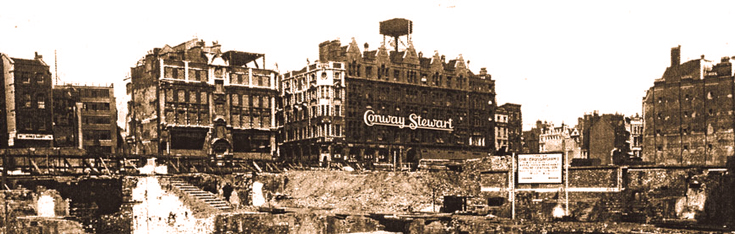
We took many a photo leaning against that wall opposite the Conway Stewart factory with those dramatic scenes behind us. Unfortunately, I disposed of them some years ago, as I started to de-clutter.
My friends and I used to go up to the Stone Gallery in St. Paul's Cathedral every Tuesday to eat our lunch and soak up the atmosphere as we looked across London. The newspaper giants (the daily papers) were in Fleet Street then and the buildings looked enormous to us. The Conway Stewart building itself was imposing, but very old inside.
Probably due to the bombed out buildings around us, we sometimes were invaded by rats. They came in from the cold as it were! Rat catchers would come in if any droppings were found and poison would be put down for them in strategic places. The off-side was that the poison made the rats thirsty and they would come out to drink from the fire buckets, which were placed by the walls around the department. I never saw them drinking from the buckets but we were told that this is what they did. They drank copiously and would mainly go under the floorboards to die. This created a smell and the rat catchers would come and take the boards up to remove them.
 But on one occasion, soon after I joined the company, I was giving out the morning rolls when someone quietly said to me, "Look up" and just above a lady (who was a bit older than me but became a very good friend) was a huge rat, obviously bloated with water and gradually losing its grip on the pipe which went around the room.
“What do we do?” “She will be so scared!” we said.
But on one occasion, soon after I joined the company, I was giving out the morning rolls when someone quietly said to me, "Look up" and just above a lady (who was a bit older than me but became a very good friend) was a huge rat, obviously bloated with water and gradually losing its grip on the pipe which went around the room.
“What do we do?” “She will be so scared!” we said.
For a few seconds the rat struggled to stay up on the pipe, but before we could warn anybody, it fell down. Panic stations? You bet! She screamed and ran, we screamed and ran. But was that the last we saw of her? Indeed not. Even rats couldn’t keep her away. She was soon back at her bench and went on to work for Conway Stewart for many years – a testament to the great atmosphere in the company".