
It’s no secret that I’ve been a huge fan of the modern Conway Stewart pens...
 I was having a hard time finding a point of reference for the new Conway Stewart Coronet. But fortuitously enough, while I was playing around with the Coronet I received the June issue of the Conway Stewart newsletter. Featured was a brief piece about the Book of Numbers, an online compilation of Conways over the years.
From Conway Stewart’s inception in 1905 until its rebirth in the 1990s, a truly bewildering array of pen models were produced. The Book of Numbers is an attempt to make some sense of all of these models. I lost track after a couple of hundred variants. Suffice it to say, a large part of Conway Stewart’s pen production strategy has been one of addition, refinement, and replacement. This holds true to modern day Conway Stewarts as well. Since I’ve been collecting I can’t even count the number of different Conway Stewart model lines have been produced. Designs have come and gone, been stretched or compacted, rounded or squared, offered in different colours or materials. It’s one of my favourite things about Conway Stewart. There’s always something new around the corner.
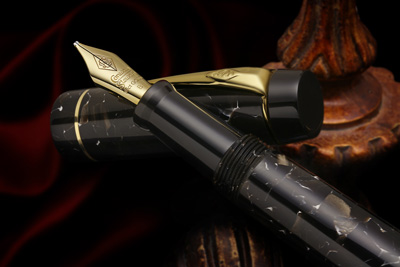
After consulting the Book of Numbers as well as my copy of Fountain Pens of the World, I decided the 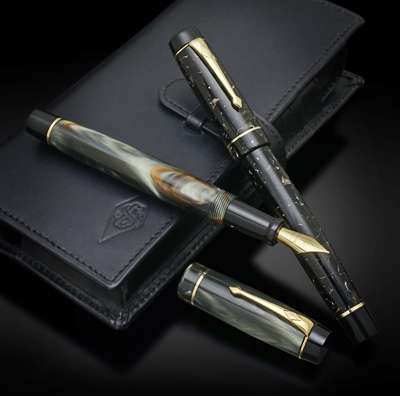 Coronet mostly closely recalls the pre-war Model 475. But compared to more recent production Conways, the Coronet is a sort of a spiritual successor to the Duro. It’s just a bit smaller and features a smaller nib, but it shares similar overall form and proportions. The pen is squarely aimed at the mid sized market, coming in between the Pelikan M600 and M800 in size. It’s pretty much a flat top design, with mild curve to the cap and barrel, which adds a little visual interest. The trim is clean and simple, with a truncated version of the standard Conway Stewart clip and three 18k gold trim rings. Other than the classic Conway Stewart imprint, there’s little embellishment to the strong but simple form of the Coronet.
Though the design of the pen eschews any kind of frilliness, the materials available can be quite interesting. These range from the more restrained and classic Dartmoor and Walnut to the more vivid Exmoor to the wild Turquoise Fleck. While I’m partial to the Dartmoor model I tested, with its flakes of rich, dark brown suspended in deep black resin, I also find the Brown Whirl model to be quite appealing. I’m into grey pens and inks lately, and the Brown Whirl is basically a nice cool pearly grey, with a thin ribbon of warm brown throughout. I like the contrast of colour and temperature. No matter what material is chosen, the section, cap, and barrel ends are solid black.
The first modern Conway Stewart pens were the 58 models, which featured a fantastic small nib that sold me on the Conway Stewart brand. In particular, the Italic Fine nib that came on my first 58 set the gold standard for italic nibs in 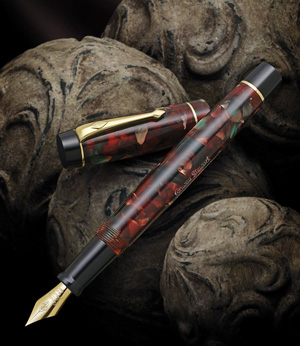 my collection. I’m very happy to see this smaller nib has returned to the Conway Stewart line on the new Coronet. The model I tested had a much more standard 18k yellow gold Medium nib. But the Medium was still a great nib, smooth and sweet with just a touch of spring. A little variation in pressure can result in a bit of line variation. Nothing like true flex, but enough to add a little zest to your writing.
The Coronet features a solid resin construction, without the brass lining that has been a feature of many recent Conway Stewarts. This gives the pen a lighter weight without upsetting the balance. The barrel is long enough to allow the pen to be used comfortably without posting the cap, though if you prefer to post (like I do) the cap the balance is still good. The construction of the pen is quite solid. In particular the resin material seems to have been turned to be slightly thicker in the walls, which means the pen still has a good, solid feel.
The Coronet sits as the new entry level pen to the Conway Stewart pen range. Even though it’s the most affordable pen in the range, though, it features many of Conway Stewart’s most exceptional features. These include solid 18k gold nib and trim crafted from high quality marbled resins. This is a great pen to introduce anyone to the world of Conway Stewart. And over the years I expect to see it offered in a wider range of materials, perhaps receiving alterations in trim or form. Here’s a pen that certainly deserves a place in Conway Stewarts’ Book of Numbers.
Doug Vicary
Pennsylvania, USA